


Which Fujifilm Camera Should You Get?

Spend five minutes in any photography group or forum and you'll see this question come up constantly. And within seconds, well-meaning photographers pile in with their recommendation — which is almost always the camera they own — along with a detailed explanation of why everything else falls slightly short.
Here's the thing. They're not wrong. But they're not entirely right either.
The truth is that every Fujifilm camera is good. Every single one. With today's sensors, processors, and lenses, pretty much any camera in the range is capable of producing stunning images in the right hands. The fact that one model doesn't have a feature that another one does doesn't make it a poor camera — it just makes it a different camera, designed with different priorities in mind.
What those forum debates rarely address is the thing that actually matters most: which camera is right for you, and how you shoot. That's what this is about. No spec sheets, no pixel-peeping, no agenda. Just the stuff that actually matters when you're standing in a camera shop with your wallet out.
First, forget the model numbers for a minute
The biggest mistake people make is jumping straight to "should I get the X-T5 or the X-S20" before they've answered a more important question: what kind of photographer are you?
Not what kind you aspire to be on your best day. What kind you actually are on a normal Tuesday.
Do you want a camera that lives in your bag permanently — something that comes out on evenings, weekends, city breaks, without you even thinking about it? Or are you someone who plans dedicated photography sessions, goes out specifically to shoot, and doesn't mind carrying something a bit more substantial?
This matters more than any spec sheet, because here's the uncomfortable truth: a camera you take with you every day is cheap per shot. A camera that sits on a shelf because it's too big or too complicated is the most expensive camera you'll ever own.
The best camera is the one you actually take with you. Everything else follows from there.
Fujifilm cameras broadly come in two flavours. Fixed lens (one built-in lens, nothing to change) and interchangeable lens (you can swap lenses around). That's the first decision. Everything else follows from there.
One more thing before we get into models — you can't really go wrong
Fujifilm cameras hold their value remarkably well. Better than almost any other brand. So if you buy one, use it for a year, and decide you want something different — you'll get most of your money back when you sell it. Getting the decision slightly wrong isn't a disaster. It's just a stepping stone to knowing what you actually want.
The "just want one simple camera" option — X100VI
If the idea of choosing lenses fills you with dread, the X100VI is for you.
It has one lens built in. You can't change it. And for a lot of people, that's not a limitation — it's a relief. One less thing to think about means more brain space for actually taking photos.
It's small enough to slip in a jacket pocket, it's beautifully quiet, and it produces gorgeous images straight out of the camera. It's the camera I'd recommend to someone who wants to just get on with it without building a whole kit.
The catch? It's popular. Finding one in stock at a sensible price can take some patience.
The "I want flexibility" options — interchangeable lens cameras
If you like the idea of being able to use different lenses for different situations — wide for landscapes, a bit longer for street portraits, that sort of thing — then you want an interchangeable lens body.
Don't panic. You don't need a bag full of lenses to start. One body and one lens is all you need. Add more later when you know what you're missing.
Here's a simple breakdown by what matters to you:
If small and light is the priority
The X-T50 is a lovely little camera. Classic dials, feels great in the hand, and pairs beautifully with a small 27mm lens. It's the kind of camera you'll actually take out every day rather than leaving at home because it's too much faff.
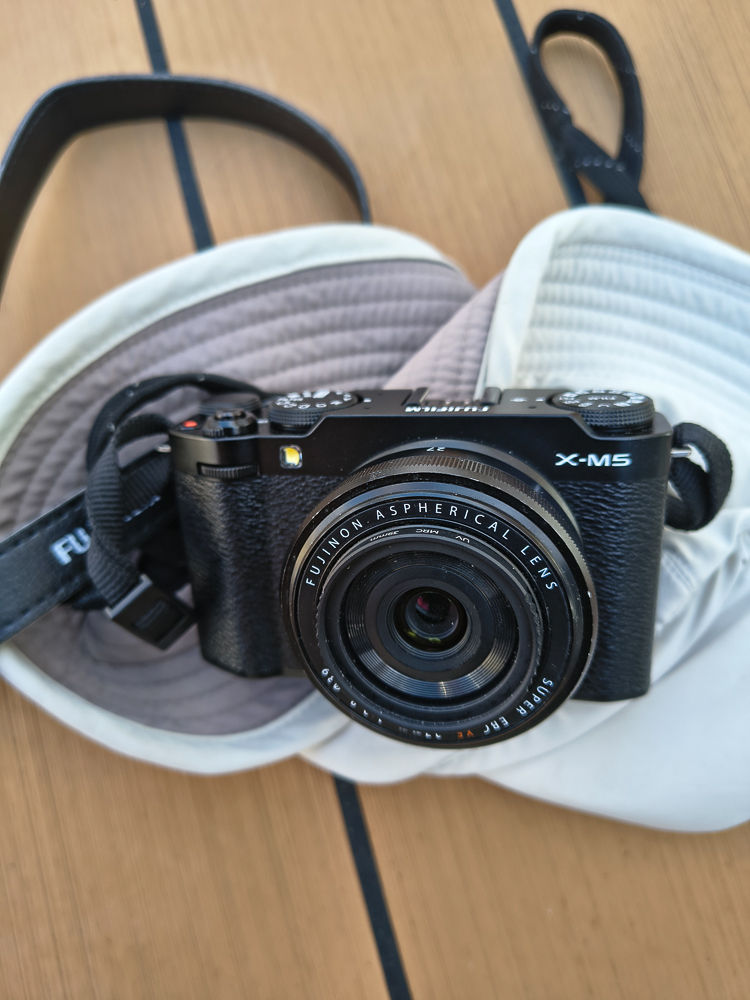
The X-M5 is worth a serious look if you're also interested in video. It's compact, modern looking, and punches well above its price point for video quality — great if you're thinking about social content, YouTube, or just want to capture family moments properly rather than relying on your phone. It's more menu-driven than the X-T50 which puts some people off, but if dials and buttons aren't your thing it might actually suit you better.
If you want small, discreet and a bit different
The X-E5 is worth knowing about. It's a rangefinder-style body — meaning it's more rectangular and understated than the traditional camera shape — and it's genuinely small. It pairs beautifully with Fujifilm's compact prime lenses and the whole combination disappears into a small bag or even a large pocket.
If you're drawn to street photography, travel, or just want a camera that doesn't scream "I'm a photographer" when you're out and about, the X-E line has real appeal. It's capable, it's discreet, and it looks more like a classic film camera than a modern DSLR — which for some people is exactly the point.
The X-S20 is a brilliant all-rounder. It handles everyday photography, portraits, travel, and a bit of video without breaking a sweat. It's friendly for beginners but capable enough to still be useful when your skills develop. Start here if you're genuinely not sure.
If you're serious about stills and want the best
The X-T5 is where you end up when you've decided photography is properly your thing. Stunning image quality, weather sealed, classic dials, and files that hold together beautifully when you print large. It's not a beginners camera particularly — but it's the one you probably won't want to upgrade from in a hurry.

Don't overthink the lenses
Here's something the forums won't always tell you: kit lenses are actually pretty good.
A kit lens is the zoom lens that often comes bundled with a camera body at a discounted price. You'll regularly find decent deals on camera and kit lens combinations — and buying that way usually works out cheaper than buying body and lens separately. Worth looking out for.
The photography internet has a habit of dismissing kit lenses as second-rate, but that's largely nonsense. I still reach for mine for travel. They cover a useful zoom range, they're light, they're versatile, and in most everyday situations they'll produce images you'll be genuinely proud of. For a beginner especially, a kit lens will do everything you need while you figure out what kind of photography you enjoy.
When you do start thinking about additional lenses, prime lenses are worth exploring. A prime is a fixed focal length — it doesn't zoom — and they tend to be smaller, sharper at wide apertures, and great for learning because they make you move rather than just zoom. The 27mm is a popular starting point — tiny, sharp, and the field of view feels natural and close to what your eyes see. The 35mm is another good option if you tend to stand a bit further back from your subjects.
But don't feel you need to rush there. Start with whatever lens comes with your camera, use it until you understand what it isn't giving you, and then think about what to add next.
A word on budget

As mentioned earlier, Fujifilm cameras hold their value well, so buying used is a perfectly sensible approach — the second hand market is healthy and most people look after their kit.
Roughly speaking:
Entry level — X-M5, X-T50, X-S20. Great cameras. More than capable for anything you're likely to throw at them.
Mid range — X-T5. The step up that makes sense when you're ready for it.
"I've caught the bug badly" — GFX medium format. Gorgeous files, large prints, serious money. Don't start here.
Not sure still? Let Fujifilm help you decide

If you've read all of this and you're still not quite sure, Fujifilm have a handy interactive tool on their own website that asks you a few simple questions about how you shoot and what matters to you, then points you toward the right camera. It's worth five minutes of your time before you commit.
Pick a body style first — fixed lens if you want simplicity, interchangeable if you want flexibility.
If you want simple: X100VI.
If you want flexible and friendly: X-S20 or X-T50 with a 27mm lens.
If you want the best stills camera in the range: X-T5.
Buy one body. Buy one lens. Go out and use it for six months before you start worrying about what else you might need.
The photos don't come from the camera. They come from you turning up and paying attention. The camera just records what you saw.
Now stop reading and go buy one.
Questions? Drop them in the comments below — happy to help.


Comments